
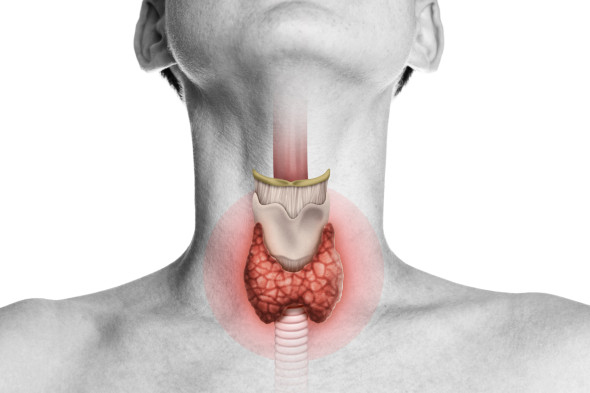
Pathophysiology and Oral Implications
The thyroid gland — metabolic conductor and its oral repercussions
The thyroid gland secretes triiodothyronine (T3) and thyroxine (T4), orchestrating basal metabolism, tissue growth and thermal regulation. These hormones act on virtually every cell in the body through nuclear receptors that modulate gene transcription and protein synthesis.
Recent research has demonstrated the presence of TSH receptors within periodontal tissues themselves, confirming that thyroid hormonal balance actively participates in maintaining the integrity of the tooth-supporting apparatus. Any imbalance — excess or deficit — disrupts this homeostasis with clinical consequences directly observable in daily dental practice.
Thyroid hormone influence on oral structures
| Physiological aspect | Thyroid hormone influence | Consequences of imbalance |
|---|---|---|
| Bone metabolism | Remodelling regulation and mineral density | Alveolar osteoporosis or delayed healing |
| Dental development | Eruption timeline and odontogenesis | Early or delayed eruption, enamel hypoplasia |
| Salivary function | Secretion and ionic composition | Xerostomia, altered pH and salivary calcium |
| Immune response | Pro-inflammatory cytokine modulation | Exacerbation of periodontitis |
Comparative Oral Manifestations
Hyperthyroidism (Graves' disease)
- Increased susceptibility to dental caries and aggressive periodontitis
- Rapid alveolar bone destruction — accelerated attachment loss
- Children: premature exfoliation of primary teeth, accelerated eruption
- Malocclusions due to early maxillary growth
- Xerostomia (secondary Sjögren's syndrome) amplifying caries risk
- Burning mouth syndrome (glossodynia) and taste disturbance (dysgeusia)
Hypothyroidism (Hashimoto, iatrogenic)
- Macroglossia due to myxoedematous infiltration (glycosaminoglycans)
- Dental imprints on the lateral borders of the tongue
- Delayed tooth eruption in children, malocclusions
- Reduced salivary calcium and phosphate → enamel fragility
- Persistent gingivitis, impaired microcirculation, delayed wound healing
- Swelling of the salivary glands
Comparative table of oral manifestations
| Manifestation | Hyperthyroidism | Hypothyroidism |
|---|---|---|
| Eruption timeline | Accelerated | Delayed |
| Tongue | Burning mouth, glossodynia | Macroglossia (myxoedema) |
| Salivary glands | Sialadenitis, xerostomia | Glandular swelling |
| Periodontium / bone | Rapid alveolysis, osteoporosis | Gingivitis, slow healing |
| Enamel | Rapid caries development | Hypoplasia, poor mineralization |
Clinical Assessment — TSH and 2024-2025 Guidelines
The central role of TSH — HAS 2024 recommendations
Serum TSH measurement is the single first-line test. In 90% of cases, a normal TSH is sufficient to rule out a clinically significant thyroid disorder. For the dental practitioner, euthyroid status is defined by a TSH between 0.4 and 4.0 mIU/L.
Population-specific nuances exist: in pregnant women the target is lower (< 2.5 mIU/L in the first trimester); in older patients (> 65 years), a mildly elevated TSH may be physiological.
Decision table — TSH and dental management approach
| Clinical category | TSH (mIU/L) | Dental management approach |
|---|---|---|
| Euthyroidism (normal) | 0.4 – 4.0 | Routine care — no special precautions required |
| Subclinical hypothyroidism | 4.0 – 10.0 | Care possible — monitor clinical signs |
| Subclinical hyperthyroidism | 0.1 – 0.4 | Caution with epinephrine — stress management essential |
| Overt thyroid disorder | < 0.1 or > 10.0 | Defer elective care — specialist opinion required |
Operative Precautions and Risk Stratification
ASA classification — Systematizing the clinical approach
A treated and well-controlled patient is classified as ASA II and may be treated normally. A patient with suggestive symptoms or unstable laboratory values is classified as ASA III: any non-urgent invasive procedure must be deferred until medical stabilization and specialist clearance.
Hyperthyroidism — Major precautions
- Epinephrine strictly contraindicated in the unstabilized patient
- Risk of ventricular arrhythmia, severe tachycardia and thyroid storm
- Operative stress management: short appointments, calm environment
- Avoid high-dose aspirin (displaces T3/T4 from plasma-binding proteins)
- Coagulation screen (PT/INR) if patient is on propylthiouracil (PTU)
Hypothyroidism — Major precautions
- Avoid or drastically reduce doses of benzodiazepines, barbiturates and opioids
- Risk of critical metabolic slowdown under sedatives
- Prolonged local pressure after extractions (delayed healing)
- Reinforced postoperative follow-up — dry socket (alveolitis) risk elevated
- Caution with iodine-based antiseptics (risk of transient thyroiditis)
Vasoconstrictors and Local Anaesthesia
Epinephrine is strictly contraindicated. Excess thyroid hormones sensitize the myocardium to catecholamines — risk of ventricular arrhythmia and chair-triggered thyroid storm.
Vasoconstrictor permitted within the limit of 0.04 mg epinephrine per appointment, equating to ≈ 2 cartridges at 1:100,000 or 4 cartridges at 1:200,000. Pre-injection aspiration is mandatory.
Anaesthetic alternatives by thyroid status
| Clinical situation | Recommended anaesthetic | Precaution |
|---|---|---|
| Euthyroidism (normal TSH) | Articaine or lidocaine + epinephrine | Max dose 0.04 mg epinephrine per appointment |
| Subclinical hyperthyroidism | Articaine 1:200,000 in limited dose | Systematic aspiration, blood pressure monitoring |
| Unstabilized hyperthyroidism | Mepivacaine 3% without vasoconstrictor | Deferral of elective procedure recommended |
| Severe hypothyroidism | Articaine with vasoconstrictor — cautiously | Avoid sedatives — extreme CNS depressant sensitivity |
Haemorrhagic Risk and Wound Healing
Hypothyroidism — Bleeding and healing
- Mucopolysaccharides in vessel walls → inadequate reflex vasoconstriction after extraction
- Reduced fibroblast metabolic activity → slowed collagen synthesis
- Elevated risk of dry socket (alveolar osteitis)
- Prolonged local pressure + rigorous postoperative monitoring mandatory
Hyperthyroidism — Bleeding risk
- Propylthiouracil (PTU): documented anti-vitamin K activity
- Coagulation screen (PT/INR) before invasive surgery in PTU-treated patients
- Methimazole and carbimazole: agranulocytosis risk — CBC surveillance required
- Verify recent CBC before any surgical intervention
Drug Interactions
Interactions affecting levothyroxine (L-T4) bioavailability
Levothyroxine is one of the most prescribed drugs worldwide. Its bioavailability is extremely sensitive to the gastrointestinal environment. Several agents common in dental practice can impair its absorption.
Form insoluble chelates with thyroxine, blocking intestinal absorption.
Mandatory rule: a minimum of 4 hours between L-T4 intake and any calcium or iron supplement.
Reduce gastric acidity needed to dissolve L-T4. Frequently co-prescribed with dental NSAIDs.
Recommendation: take L-T4 on an empty stomach, well apart from PPIs.
Displaces T3/T4 from plasma-binding proteins (TBG), abruptly raising the free fraction — risk of triggering or worsening thyrotoxicosis in hyperthyroid patients.
Paracetamol (acetaminophen) remains the first-line analgesic.
Potent inducer of hepatic thyroxine metabolism. Risk of leaving the patient hypothyroid despite substitutive therapy.
TSH monitoring recommended if co-prescribed.
Summary drug interaction table for dental practice
| Dental drug | Type of interaction | Clinical recommendation |
|---|---|---|
| Aspirin (> 500 mg) | Raises free T4 by protein displacement | Avoid in hyperthyroidism |
| Omeprazole (PPI) | Reduces L-T4 absorption | L-T4 on empty stomach, PPI at a distance |
| Calcium carbonate | Chelation — reduces L-T4 bioavailability | 4-hour separation mandatory |
| Ketamine | Increased hypertension and tachycardia | Avoid for parenteral sedation |
| Povidone-iodine (Betadine) | May trigger thyroiditis in susceptible patients | Prefer chlorhexidine if in doubt |
| Amoxicillin / Metronidazole | No major interaction with L-T4 | Safe — routine use |
| Ciprofloxacin | May interfere with thyroxine absorption | Vigilance — separate dosing |
Dental Office Emergencies
Radiation Protection and Iodine-Based Antiseptics
Thyroid radiation protection
- Repeated low-dose ionizing radiation is a recognized risk factor for thyroid nodules and carcinomas
- Systematic use of a lead thyroid collar during every dental radiograph — without exception
- Prefer digital RVG (significantly reduced doses) — especially in thyroid patients and children
- Justify and optimize every radiographic prescription
Iodine-based antiseptics — Povidone-iodine
- Exposure to povidone-iodine (Betadine) can interfere with thyroid function
- Particularly in patients with antithyroid antibodies or autoimmune predisposition
- Risk of triggering transient thyroiditis
- When in doubt: substitute with chlorhexidine (iodine-free solution)
Clinical FAQ
References
Clinical guidelines and recommendations
-
1HAS 2024 Haute Autorité de Santé (HAS). TSH measurement and thyroid function assessment: clinical practice recommendations 2024.
has-sante.fr — TSH recommendations 2024 -
2ATA 2025 American Thyroid Association. What Has Changed in the 2025 ATA Management Guidelines for Adult Patients with Differentiated Thyroid Cancer. PMC / Thyroid.
pmc.ncbi.nlm.nih.gov — ATA 2025 guidelines DTC -
3Algeria Faculty of Medicine, University of Constantine 3. General diseases and restorative dentistry.
facmed.univ-constantine3.dz — General diseases and dentistry
Oral manifestations and periodontology
-
4The effects of thyroid function on periodontal status: a systematic review. PMC / J Clin Periodontol.
pmc.ncbi.nlm.nih.gov — Thyroid and periodontal status -
5Review Oral manifestations of thyroid disorders and its management. PMC / J Family Med Prim Care.
pmc.ncbi.nlm.nih.gov — Oral manifestations of thyroid disorders -
6Bidirectional Association between Periodontitis and Thyroid Disease. MDPI / Biomedicines.
mdpi.com — Periodontitis and thyroid disease -
7Study Association between Dental Variables and Hashimoto's Disease: A Retrospective Cohort Study. PMC.
pmc.ncbi.nlm.nih.gov — Hashimoto's disease and dental variables
Drug interactions and emergencies
-
8Review Pharmacological Interactions of Levothyroxine in Multiple-Treated Patients. ResearchGate / Thyroid Research.
researchgate.net — Levothyroxine drug interactions -
9Review Drugs Affecting Levothyroxine Absorption. Pharmacy Times.
pharmacytimes.com — Drugs affecting L-T4 absorption -
10Case report Management of hyperthyroid patients in dental emergencies: a case report. PMC / NIH.
pmc.ncbi.nlm.nih.gov — Hyperthyroidism in dental emergencies -
11Review Acute and emergency care for thyrotoxicosis and thyroid storm. PMC / Endocrinology.
pmc.ncbi.nlm.nih.gov — Emergency care for thyroid storm -
12Case report Severe Agranulocytosis and Thyroid Storm Triggered by Reinitiating Low-Dose Thiamazole. PMC.
pmc.ncbi.nlm.nih.gov — Agranulocytosis and antithyroid drugs