
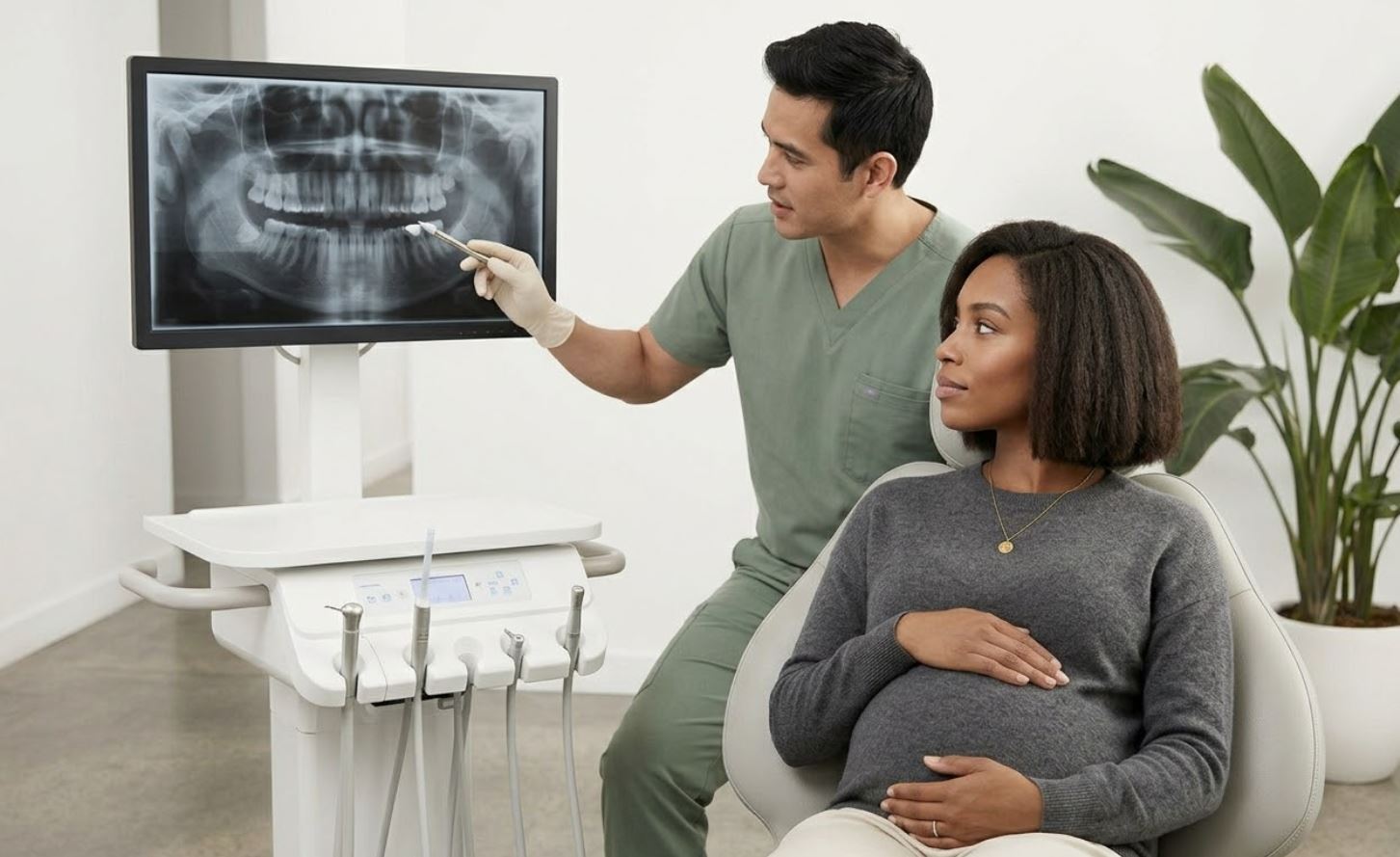
Why Treat Pregnant Patients?
Common Misconceptions vs. Clinical Reality
Many pregnant women hesitate to visit the dentist out of concern for their unborn child, and some practitioners are also reluctant to intervene during pregnancy. Yet there are no absolute contraindications to dental care during pregnancy — quite the opposite: neglecting oral health during this period can lead to serious obstetric complications.
Impact of Periodontal Disease on Pregnancy
- Increased risk of preterm birth before week 37
- Documented association with preeclampsia and gestational hypertension
- Intrauterine growth restriction (IUGR)
- Low birth weight (< 2,500 g)
- Stimulation of uterine contractions via infection-derived prostaglandins
Trimester-by-Trimester Approach
Sensitive Period
- Active organogenesis — elevated miscarriage risk
- Urgent care only: emergency extractions, root canal for acute infection or pain
- Defer elective treatment until after month 3
- Nausea and hypersalivation — adapt session length
- Avoid non-essential radiographs
Ideal Period ✓
- Fetus fully formed — patient generally comfortable
- Conservative care: caries, endodontics, non-urgent extractions
- Address evolving infectious foci
- Preferred window for radiographic examination if needed
- Defer complex prosthetic work until after delivery
Near Term
- Significant positional discomfort — semi-reclined position mandatory
- Risk of supine hypotensive syndrome (caval compression)
- Urgent and palliative care only
- Short sessions with frequent breaks
- Preterm labor risk must be considered
Permitted and Contraindicated Medications
Analgesics — Reference Table
| Drug | T1 (0–3 mo) | T2 (4–6 mo) | T3 (7–9 mo) | Notes |
|---|---|---|---|---|
| Paracetamol (Acetaminophen) | Permitted | Permitted | Permitted | Reference analgesic — 1 g / 6 h max |
| Ibuprofen / NSAIDs | Discouraged | Last resort only | Prohibited | Fetotoxic in T3 — premature closure of ductus arteriosus |
| Aspirin | Discouraged | Discouraged | Prohibited | Maternal and fetal hemorrhage risk |
| Codeine | Avoid | Min. dose / short course | Avoid | Risk of neonatal respiratory depression |
| Tramadol | Avoid | Exceptional | Avoid | Hospital use only, under strict supervision |
| Morphine | Exceptional | Exceptional | Exceptional | In-hospital only — alert neonatal team if delivery is imminent |
Antibiotics — Reference Table
| Antibiotic | T1 | T2 | T3 | Indication |
|---|---|---|---|---|
| Amoxicillin | Permitted | Permitted | Permitted | First-line — dental infections |
| Amoxicillin + Clavulanate | Permitted | Permitted | Caution | Severe infections — risk of neonatal enterocolitis in preterm |
| Spiramycin | Permitted | Permitted | Permitted | Penicillin allergy — reference macrolide in pregnancy |
| Azithromycin | Permitted | Permitted | Permitted | Macrolide alternative — no proven teratogenicity |
| Clindamycin | Permitted | Permitted | Permitted | Penicillin allergy — reassuring safety data |
| Metronidazole | Avoid if possible | Permitted | Permitted | Anaerobic infections — no significant teratogenic effect shown |
| Tetracyclines / Doxycycline | Prohibited | Prohibited | Prohibited | Fetal tooth and bone abnormalities — grey discoloration |
| Fluoroquinolones | Prohibited | Prohibited | Prohibited | Fetal cartilage toxicity — a safer alternative always exists |
Topical Antiseptics
- Chlorhexidine 0.12–0.20%: permitted all trimesters
- Cetylpyridinium chloride: safe throughout pregnancy
- Minimal systemic absorption — no adverse effects reported
- Choose alcohol-free mouthwashes
- Povidone-iodine (Betadine®): brief punctual use OK — avoid prolonged use (fetal thyroid function)
Dental Materials
- Composite resin, RMGIC, glass ionomer: no contraindication
- Zinc oxide eugenol: acceptable for temporary use
- Dental amalgam: PROHIBITED in pregnant women (EU Regulation — Minamata Convention, since July 2018)
- Amalgam removal: avoid unless absolutely necessary — use rubber dam + high-volume evacuation
Local Anesthesia — Protocol for Pregnant Patients
Lidocaine with Epinephrine
- Best-documented local anesthetic in pregnant patients
- Used for decades without adverse fetal outcomes
- Xylocaine® 2% with epinephrine — first-choice recommendation
- Mandatory aspiration before every injection
Articaine with Epinephrine
- Alphacaine®, Septanest®, Ubistesine®: suitable for use
- High protein binding — limits placental transfer
- Rapid plasma hydrolysis
- Slightly less data than lidocaine in T1 — no adverse effects reported
Vasoconstrictor (Epinephrine) — Recommended
Use of epinephrine is not only permitted but recommended: it reduces systemic absorption of the anesthetic, prolongs and deepens anesthesia, minimizes bleeding, and shortens the procedure.
Essential Rules
- Aspirate before every injection — prevent inadvertent intravascular delivery
- Use only the amount strictly necessary (0.04 to 0.1 mg per cartridge)
- At standard dental doses, epinephrine has no significant effect on uteroplacental perfusion
- Pain and stress → endogenous catecholamine surge far greater than exogenous epinephrine at dental doses
Pregnancy Physiology — Practical Implications
Potential anesthesia challenges
- Mucosal hypervascularity and slight tissue acidification → reduced local anesthetic efficacy (weak bases less ionized at lower pH)
- Higher anesthetic doses may be needed — do not hesitate to supplement
- Prefer nerve blocks over infiltration when analgesia is insufficient
Chair position — from the 3rd trimester
- Avoid full supine position → risk of aortocaval compression reducing venous return
- Semi-reclined position, or place a wedge under the right hip to tilt toward the left
- Watch for presyncope signs: pallor, nausea, hypotension
Dental Radiographs and Pregnancy
Radiation Doses in Perspective
| Examination | Uterine dose (µGy) | Recommendation |
|---|---|---|
| Periapical / Bitewing X-ray | 1 to 8 µGy | No restriction with shielding |
| Panoramic (OPG) | Tens of µGy | If clinically justified |
| CBCT (Cone Beam CT) | Hundreds of µGy | Only if absolutely necessary |
| Medical CT (full body) | > 1,000 µGy | Specialist consultation required |
| Fetal risk threshold | 100,000 µGy (100 mGy) | Far above any dental X-ray dose |
Radiation Protection Best Practices
- Lead apron on abdomen for every radiograph in a pregnant patient — provides reassurance and additional shielding
- Thyroid collar when available
- Collimate the X-ray beam to the area of interest — use rectangular collimation
- Digital sensors or high-speed films (minimize exposure time)
- Avoid non-urgent radiographs in the 1st trimester — defer if clinically safe to do so
- Never withhold a necessary radiograph because of pregnancy: a missed diagnosis is more dangerous
Managing Dental Emergencies During Pregnancy
Why Emergencies Must Not Be Deferred
A progressing dental abscess can trigger fever, uterine contractions, and potentially preterm labor. Severe pain releases stress catecholamines that reduce uteroplacental blood flow. Failing to treat a dental emergency is far more dangerous than treating it correctly.
Irreversible Pulpitis — Acute Toothache
Severe spontaneous, throbbing pain disrupting sleep. Priority intervention: pulp chamber access / emergency pulpectomy.
- Effective local anesthesia (lidocaine with epinephrine)
- Access opening + partial or complete pulp removal under rubber dam
- Intracanal medicament + temporary restoration
- Complete endodontic treatment preferably in T2 if presenting in T1 or T3
- Paracetamol 1 g / 6 h — sole option in T1 and T3
- Codeine added to paracetamol for severe uncontrolled pain — T2 only, minimum dose, shortest possible course
- NSAIDs: absolutely contraindicated in T3 — discouraged in T1
Dental Abscess / Cellulitis
Bacterial infection with purulent collection. Drainage is the primary intervention — antibiotics alone are insufficient.
- Systematic drainage of all fluctuant collections — via endodontic access or incision depending on location
- Do not wait for delivery to drain a collection
- Periodontal curettage for periodontal abscesses
- Amoxicillin 500–1000 mg × 3/day — 5 to 7 days (all trimesters)
- + Metronidazole for anaerobes (apical periodontitis) — from week 14 onward with caution
- If allergic: spiramycin or clindamycin
- Paracetamol 1 g / 6 h
- Chlorhexidine 0.12% alcohol-free mouthwash
Pericoronitis — Wisdom Tooth
Acute pericoronal inflammation, often recurrent.
- Thorough irrigation with chlorhexidine 0.12%
- Careful debridement under the operculum
- If severe infection: amoxicillin + metronidazole (trimester-dependent)
- Extraction of the causative tooth preferably in T2
- Avoid scheduling in T3 unless absolutely necessary
Anxiety Management in Pregnant Patients
Psychological and Behavioral Approach
The vast majority of pregnant patients can be treated without difficulty once they feel heard and reassured. Explain each step, emphasizing its safety for the baby.
Practical Chairside Tips
- Create a calm, reassuring atmosphere — unhurried tone and demeanor
- Allow a support person in the room if desired
- Agree on a hand signal to pause treatment — patient maintains sense of control
- Keep sessions shorter in late pregnancy — supportive pillows for comfort
- Manage gag reflex: avoid over-reclining the chair, rinse frequently, light topical spray if needed
- Relaxation techniques: slow nasal breathing, music through earphones, breathing methods from birth preparation classes
Nitrous Oxide — N₂O/O₂ (50/50)
- Contraindicated in T1 — critical period of fetal organogenesis
- Permitted in T2 and T3 for uncontrollable anxiety
- 50/50 O₂/N₂O blend — rapid onset and rapid elimination
- 30% N₂O often sufficient (heightened sensitivity during pregnancy)
- Effective scavenging system mandatory — protect the dental team
- Requires specific practitioner training and monitoring
Pharmacological Anxiolytics
- Benzodiazepines (diazepam, midazolam): discouraged — especially T1 (cleft palate risk) and T3 (neonatal hypotonia)
- Single dose in T2: no major documented consequence — not recommended without specialist input
- Severe dental phobia: refer to specialized center for IV sedation or GA in a controlled hospital setting
- Valerian / Passionflower: modest effect, generally safe — after physician advice
Sample Prescriptions
Dental Pain — All Trimesters
Rx 1Dental Infection — 1st Trimester
Rx 2Anaerobic Infection — From Week 14
Rx 3Penicillin Allergy
Rx 4Severe Pain — 2nd Trimester Only
Rx 5Post-Operative Antisepsis
Rx 6Clinical FAQ
References
- HAS & Assurance Maladie — Oral health examination during pregnancy, prevention programme (2018–2024)
- ACOG — Committee Opinion No. 569: Oral Health Care During Pregnancy (2013, reaffirmed)
- ADA — MouthHealthy: Pregnancy and Dental Concerns (2025)
- RFCRPV Nouvelle-Aquitaine — Management of dental problems during pregnancy (2019)
- UFSBD — Advisory leaflet: Pregnancy and oral health (updated June 2024)
- MotherToBaby (OTIS) — Fact Sheet: Dental Work and Pregnancy (2021)
- IRSN — FAQ: Dental radiology and pregnancy (Institut de Radioprotection et de Sûreté Nucléaire, 2020)
- AAPD — Guideline on Perinatal Oral Health Care (American Academy of Pediatric Dentistry, 2017)
- EU Regulation 2017/852 on mercury — Dental amalgam restrictions (2018)
- WHO — Oral health and pregnancy: recommendations for health professionals (2022)