Conscious sedation makes it possible to treat anxious, phobic or poorly cooperative patients without resorting to general anaesthesia. In general practice it relies on two families of tools: inhalation of the 50% nitrous oxide/oxygen equimolar premix (known in French-speaking countries as MEOPA) and oral premedication with hydroxyzine or a benzodiazepine. This article covers their mechanism, indications and protocol, and above all their limits, which determine patient safety far more than the choice of drug.
1 The sedation continuum
1.1 Levels defined by the patient's response
Sedation is not a binary state but a continuum, described by the American Society of Anesthesiologists in four levels: minimal sedation (anxiolysis), moderate or "conscious" sedation, deep sedation and general anaesthesia[3]. What separates them is not the drug used but the patient's clinical response: the ability to respond to a verbal command, spontaneous maintenance of a patent airway, and preserved ventilation and cardiovascular function. The key point is that the same agent can move a patient from one level to the next depending on dose, individual sensitivity and drug combinations.
| Level | Response to speech | Airway and ventilation | Who may provide it in general practice |
|---|---|---|---|
| Minimal (anxiolysis) | Normal | Unaffected | Trained dentist |
| Moderate (conscious) | Purposeful response to verbal command or light touch | No intervention required, adequate ventilation | Trained dentist, strict framework |
| Deep | Only to repeated or painful stimulation | Intervention may be required | Anaesthesiologist |
| General anaesthesia | Absent | Intervention often required | Anaesthesiologist |
1.2 What conscious sedation does not do
Conscious sedation acts on anxiety and cooperation, not on procedural pain. The nitrous oxide premix has a modest systemic analgesic effect, insufficient for an invasive procedure, and oral anxiolytics have none at all. Local or regional anaesthesia therefore remains essential for any painful procedure; sedation simply makes it easier to deliver and makes the treatment run more smoothly. The principles of local anaesthesia are covered in the clinical pharmacology module articles on local anaesthetics and vasoconstrictors.
Key point
The level of sedation is defined by what the patient does, not by what they were given. The practitioner must be able to recognise and manage the level immediately above the one they are aiming for.
2 The nitrous oxide premix: pharmacology
2.1 A fixed-concentration premix
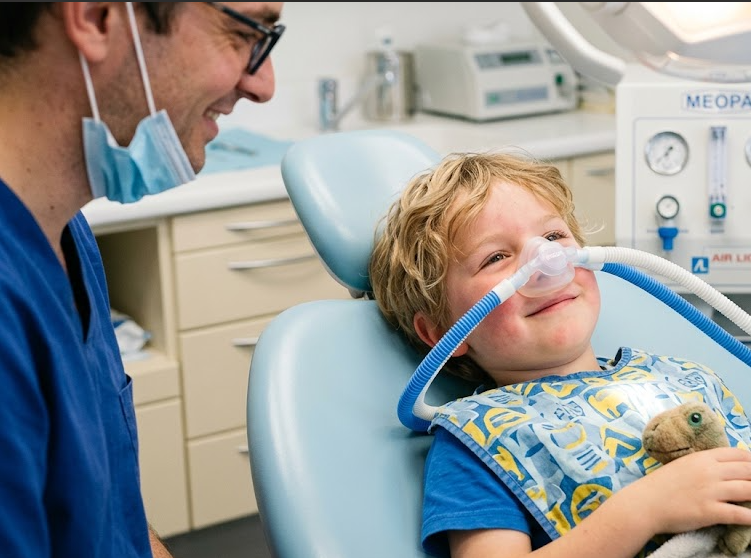
The premix is a ready-to-use gas mixture containing 50% nitrous oxide and 50% oxygen[1]. This fixed composition distinguishes it from titrated N₂O/O₂ inhalation sedation as practised in North America and the United Kingdom, where a mixing unit allows the nitrous oxide concentration to be adjusted step by step[5][6]. With the premix there is no concentration titration: the flow (or demand valve) adapts to the patient's ventilation, and the inspired oxygen fraction never drops below 50%, which accounts for much of its safety profile.
2.2 Kinetics and intended effects
Nitrous oxide is very poorly soluble in blood: the effect sets in after three to five minutes of continuous inhalation and wears off within minutes of stopping, with pulmonary elimination and no significant hepatic or renal metabolism[1]. The intended effects combine anxiolysis, mild euphoria, altered perception (a floating sensation, tingling in the extremities) and moderate systemic analgesia. The patient remains conscious, communicative and retains laryngeal reflexes.
Favourable profile
Why the premix is useful
Rapid onset and offset, high oxygen fraction, no metabolism, reversibility once inhalation stops.
Common adverse effects
Benign and reversible
Nausea, vomiting, dizziness, headache, excessive euphoria or paradoxical anxiety. They resolve when the gas is stopped.
Effects to be aware of
Linked to the physics and biology of N₂O
Diffusion into closed gas-filled spaces and inactivation of vitamin B12, the source of the main contraindications.
2.3 Safety data
A French prospective survey of more than 35,000 administrations of the premix reported an adverse event rate of a few per cent, mostly minor (nausea, vomiting, deeper sedation than intended), with serious events exceptional and mostly associated with concomitant use of other central nervous system depressants[10]. A review dedicated to the premix in conscious sedation reached the same conclusion: the mixture is safe when used alone by a trained practitioner, and risk rises mainly with drug combinations[11].
3 Indications and contraindications
3.1 Indications in dentistry
The premix is indicated in children able to accept the mask and in adults with marked anxiety or dental phobia that makes conventional treatment difficult. It also dampens an exaggerated gag reflex, making impressions, intraoral radiographs and posterior treatment easier. In patients with mild to moderate motor or cognitive disability, it often improves cooperation, provided nasal breathing is possible. It is best suited to procedures of limited duration, since mask tolerance declines over time; the summary of product characteristics also sets a maximum duration of continuous administration per session[1].
A Cochrane review of sedation for children undergoing dental treatment lists nitrous oxide among the agents with evidence supporting its effectiveness, while stressing the low overall quality of the available trials, which are often small and heterogeneous[8]. This methodological caveat should be kept in mind: clinical effectiveness is well established in practice, but the precise ranking between agents remains poorly documented.
3.2 Contraindications
Most contraindications stem from the ability of nitrous oxide to diffuse into closed gas-filled spaces faster than nitrogen can leave them, increasing their volume or pressure. Added to these are its effect on vitamin B12 and situations in which consciousness cannot be reliably monitored.
Absolute contraindications
Pneumothorax, emphysematous bullae, abdominal gas distension or bowel obstruction, gas embolism; head injury or raised intracranial pressure, impaired consciousness; diving accident; recent eye surgery with intraocular gas injection (SF₆, C₃F₈, C₂F₆) for as long as the bubble persists, i.e. several weeks to three months; known, untreated vitamin B12 or folate deficiency; facial trauma preventing mask placement.
Precautions and case-by-case assessment
Acute otitis media or recent middle-ear or sinus surgery, severe chronic respiratory failure, unstable psychiatric disorders, first trimester of pregnancy, use of other central nervous system depressants (benzodiazepines, opioids, sedating antihistamines), nasal obstruction preventing nasal breathing.
A question to ask every time
Vitreoretinal surgery with gas tamponade is an absolute contraindication that is often missed at history-taking because it seems unrelated to the mouth. In a patient who has had eye surgery within the last three months, nitrous oxide can cause a sudden rise in intraocular pressure and loss of vision.
4 Chairside administration protocol
4.1 How a session runs
The protocol below follows the sequence set out in the summary of product characteristics and in dental sedation guidance[1][6][7]. No fasting is required when the premix is used alone; a light meal a few hours beforehand is generally advised to limit nausea.
Assessment and consent
Screen for contraindications, assign an ASA class, inform the patient or legal guardians, obtain consent and explain the expected sensations.
Set-up
Nasal or oronasal mask of the right size with seal checked, scavenging system running, oxygen and suction immediately available.
Induction
Continuous inhalation for at least three minutes before any procedure, watching for signs of effect: muscle relaxation, slower speech, a relaxed facial expression.
Local anaesthesia, then treatment
Local anaesthesia is given under the premix, followed by treatment, keeping verbal contact throughout. Loss of response to speech means the gas must be stopped.
Discontinuation and recovery
Stop inhalation, monitor in the chair until baseline is restored, then check orientation and steadiness before discharge.
4.2 Oxygen at the end of the session: a debated recommendation
Giving pure oxygen after stopping nitrous oxide aims to prevent "diffusion hypoxia", described when N₂O rapidly leaves the blood and dilutes alveolar oxygen. This risk is well established after high nitrous oxide concentrations in anaesthesia, but its clinical relevance after sedation with a 50% premix remains debated: several French protocols do not require it, whereas British and North American guidance on titrated sedation calls for a few minutes of 100% oxygen[5][6]. In practice, a few minutes of oxygen at the end of the session carry no downside and remain a reasonable precaution, particularly in a patient with nausea or slow recovery.
4.3 Signs that require immediate discontinuation
Loss of verbal contact, excessive drowsiness, paradoxical agitation, nausea heralding vomiting or severe headache require stopping the gas and switching to oxygen. For premix-only sedation in an ASA I or II patient, monitoring relies mainly on continuous clinical observation; pulse oximetry becomes necessary as soon as another sedative agent is added or when the patient's condition calls for it[4][7].
4.4 Protecting the team
Chronic staff exposure to exhaled nitrous oxide is associated with neurological disorders caused by vitamin B12 inactivation, and the data on fertility effects are debated; the French occupational safety institute (INRS) recommends reducing exposure through engineering controls[12]. Effective measures are double-mask systems connected to active scavenging, adequate ventilation of the surgery, limiting the patient's talking under the mask, and stopping the gas as soon as the mask is removed. Cylinders are stored upright, secured, in a ventilated area away from heat; the mixture can separate below −5 °C, so the manufacturer's storage temperature instructions must be followed[1].
The patient talks or mouth-breathes during treatment: effectiveness drops and the gas concentration in the room rises.
Explain before the session that breathing must be through the nose and answers given by hand signals, use a rubber dam to encourage nasal breathing, and check the mask seal regularly rather than increasing the flow.
5 Oral premedication
5.1 Hydroxyzine: the first-line anxiolytic
Hydroxyzine is a sedating H1 antihistamine, not a benzodiazepine. Its anxiolytic effect is moderate, with no amnesia and no meaningful risk of dependence, making it the simplest option for mild to moderate anxiety. It is not risk-free, however: in 2015 the European pharmacovigilance committee restricted its use because of a risk of QT interval prolongation and arrhythmia[2]. Since then the maximum dose has been set at 100 mg per day in adults, 50 mg per day in older patients, in whom use is discouraged, and 2 mg/kg per day in children up to 40 kg; it is contraindicated in congenital or acquired QT prolongation and in combination with other drugs that prolong the QT interval or predispose to torsades de pointes[2].
5.2 Oral midazolam: more potent, more tightly controlled
Midazolam is a short-acting benzodiazepine that provides clearer anxiolysis and sedation than hydroxyzine, with an anterograde amnesia often welcomed by phobic patients. A Cochrane review confirms its effectiveness as premedication while noting the heterogeneity of studies and doses[9]. In children, most dental sedation protocols use 0.3 to 0.5 mg/kg orally, 20 to 30 minutes before treatment, with a maximum dose capped according to the protocol[5][8]. In adults, published oral doses are clearly higher than intravenous titration doses because of low oral bioavailability; they belong to written advanced-sedation protocols with pulse oximetry and trained staff[6][7]. The injectable form must not be swallowed as is: a suitable oral liquid preparation is required.
Hydroxyzine
Sedating H1 antihistamine
Adult: about 25 to 50 mg one hour before treatment, not exceeding 100 mg per day. Child: around 1 mg/kg, not exceeding 2 mg/kg per day. Check for QT prolongation and QT-prolonging co-medication.
Oral midazolam
Short-acting benzodiazepine
Child: 0.3 to 0.5 mg/kg, 20 to 30 minutes before treatment, under a written protocol. Adult: advanced-sedation protocols only. Pulse oximetry, mandatory escort, reversal agent (flumazenil) available.
Doses to verify
The doses given here are reference points drawn from international guidance. They must be checked against the current summary of product characteristics and the formulations actually available before any prescription, especially for midazolam, whose oral liquid form is not uniformly accessible.
5.3 Combinations: where the nature of the risk changes
Combining oral premedication with the premix is sometimes used for a very anxious patient. It is not forbidden, but it changes the risk profile: French data attribute most serious events under the premix to combinations with other central nervous system depressants[10]. A moderate dose of hydroxyzine taken before the session combined with the premix remains an option in an ASA I or II patient, provided the session is treated as potentially moderate sedation: pulse oximetry, continuous monitoring and escorted discharge. Combining the premix with a benzodiazepine, or several oral sedatives with each other, falls outside the scope of general practice and belongs to a team trained in advanced sedation[6][7]. The data on the benefit of combining hydroxyzine and midazolam in children are limited and do not support a recommendation.
6 Scope limits and referral
6.1 Discharge rules
After the premix alone, an adult who has returned to baseline may in principle leave unaccompanied after a short observation period; advice to be cautious about driving in the following hours is still recommended as a precaution. After a benzodiazepine the situation is different: the patient must be escorted home by a responsible adult, must not drive or operate dangerous machinery and must not make important decisions until the next day, as residual sedation and amnesia can persist for several hours[6]. Children always leave accompanied.
6.2 One agent, a stable patient
The reasonable scope for a dentist in general practice is minimal to moderate sedation achieved with a single agent at a standard dose in an ASA I or II patient. An ASA III or IV patient requires prior medical assessment and, in most cases, hospital-based care. Repeated failure of conscious sedation, a child too young or too resistant to accept the mask, or a need for extensive treatment are all grounds for referral to a facility with an anaesthesiologist.
6.3 When to hand over
General practice
Mild to moderate anxiety, ASA I or II patient, premix alone or hydroxyzine alone, short procedures, combined with communication techniques.
Advanced sedation
Oral benzodiazepine in adults, combined sedatives, stable ASA III patient: trained team, written protocol, monitoring.
Hospital setting
Repeated failure, refractory phobia, very young uncooperative child, severe disability, extensive treatment, unstable ASA III or ASA IV: general anaesthesia or intravenous sedation delivered by an anaesthesiologist.
6.4 The Algerian context
In Algeria, access to conscious sedation in general practice runs into concrete constraints. Premix equipment (cylinders, regulators, double masks and scavenging) is a significant investment, and its use remains mainly associated with university hospital departments; local availability of the different brands and the required training framework should be checked with distributors and professional bodies before any equipment project. Midazolam falls under the psychotropic substances regime governed by Law No. 04-18 on the prevention and suppression of the illicit use and trafficking of narcotic drugs and psychotropic substances[13]; prescribing it in general practice and obtaining an oral liquid form should be approached with caution and, in practice, in coordination with a hospital facility. Hydroxyzine, by contrast, is available in community pharmacies under several brand names.
For the private practitioner, the most accessible combination therefore remains hydroxyzine at an appropriate dose together with communication techniques (tell-show-do, systematic desensitisation, voice control, distraction). Patients with severe phobia, uncooperative children and patients with severe disabilities benefit from referral to the paediatric dentistry or oral surgery departments of university hospitals equipped for sedation or general anaesthesia.
7 Consent, records and training
7.1 Informed consent
The patient, or their legal guardians in the case of a minor, should be informed about the technique, the expected sensations, possible adverse effects, alternatives (communication alone, hospital referral) and discharge instructions. Written consent, especially for benzodiazepine premedication, protects the patient and the practitioner alike.
7.2 What the record must contain
Documentation of each session includes the indication, ASA class, the agent used and its dose or inhalation time, start and end times, clinical tolerance, any incidents, and discharge conditions (escort, time, patient status). For the premix, recording the cylinder batch number is also useful for device vigilance.
7.3 A skill to acquire and maintain
British and intercollegiate guidance holds that any sedation in dentistry requires validated theoretical and practical training, a team trained in emergency management (particularly airway management) and regular updating of skills[6][7]. The premix's summary of product characteristics also makes its use conditional on specific staff training[1]. The precise training requirements in Algeria should be confirmed with the Council of Medical Ethics before offering the technique.
Minimum equipment
An independent oxygen supply, a high-concentration mask and self-inflating bag, working suction, a pulse oximeter, a benzodiazepine reversal agent if a benzodiazepine is used, and a written emergency protocol known to the whole team.
8 Building a stepwise strategy
8.1 Start with non-pharmacological techniques
Most anxious patients can be treated without medication, thanks to a first visit with no invasive procedure, a clear explanation, the tell-show-do technique, an agreed signal to pause treatment and genuinely painless local anaesthesia. Pharmacological sedation complements these techniques and never replaces them: a sedated but poorly prepared patient is still an anxious patient.
8.2 Step up one level at a time
The safest strategy is to move to the next level only if the previous one has failed: communication alone, then hydroxyzine or the premix alone, then referral for advanced or hospital-based sedation. Stacking agents to compensate for a failure is precisely the situation in which serious incidents occur.
8.3 Organise the practice accordingly
Offering conscious sedation requires an appropriate organisation: longer appointment slots, trained staff present throughout the session, standardised consent and monitoring forms, and a posted emergency protocol. These elements echo the logic of operating standards already covered in the practice management articles: a safe technique is first of all a technique that is written down and applied the same way by the whole team.
Practical Summary
- 1
Define the level of sedation by the patient's response, never by the dose given.
- 2
Always combine with local anaesthesia: sedation treats anxiety, not pain.
- 3
Systematically screen for recent eye surgery with gas, pneumothorax and vitamin B12 deficiency before using the premix.
- 4
Check the QT interval and co-medication before hydroxyzine, and respect the maximum daily dose.
- 5
Use a single sedative agent in general practice; any combination requires monitoring and a trained team.
- 6
Require an escort and prohibit driving after any benzodiazepine.
- 7
Refer to hospital after a failure rather than adding another agent.
Frequently Asked Questions
Can the premix replace local anaesthesia for an extraction?→
No. Its analgesic effect is modest and insufficient for an invasive procedure. Local anaesthesia remains essential; the premix simply makes it easier to accept and helps the treatment run smoothly.
Can hydroxyzine and the premix be combined in a very anxious patient?→
It is possible in an ASA I or II patient with a moderate dose of hydroxyzine, provided the session is treated as potentially moderate sedation: pulse oximetry, continuous monitoring and escorted discharge. Combination with a benzodiazepine falls outside the scope of general practice.
Can a patient leave alone after a premix session?→
An adult who received the premix alone and has returned to baseline may in principle leave unaccompanied after a short observation. This no longer applies if a benzodiazepine was given, which requires an escort and a driving ban.
Is the premix suitable for very young children?→
Its effectiveness depends on accepting the mask and breathing through the nose. In very young children or those who violently refuse treatment, the mask is often poorly tolerated and inhalation ineffective: referral to a hospital department is then more appropriate.
Should pure oxygen be given at the end of the session?→
The risk of diffusion hypoxia after a 50% mixture is debated and several protocols do not require it. A few minutes of oxygen at the end of the session remain a simple precaution with no downside, particularly in the case of nausea or slow recovery.
Is specific training required?→
Yes. International guidance and the premix's summary of product characteristics require theoretical and practical training for the practitioner and the team, including emergency management. The exact requirements in Algeria should be confirmed with the Council of Medical Ethics.
References
- ANSM. Résumé des caractéristiques du produit — mélange équimolaire oxygène/protoxyde d'azote (Kalinox®, Oxynox®, Antasol®). Base de données publique des médicaments.Regulation
- European Medicines Agency, PRAC. (2015). Hydroxyzine-containing medicinal products: new measures to minimise risk of QT interval prolongation. EMA/157208/2015.Regulation
- American Society of Anesthesiologists. (2018). Practice Guidelines for Moderate Procedural Sedation and Analgesia 2018. Anesthesiology, 128(3), 437–479.Guideline
- Coté, C. J., & Wilson, S. (2019). Guidelines for Monitoring and Management of Pediatric Patients Before, During, and After Sedation for Diagnostic and Therapeutic Procedures. Pediatrics, 143(6), e20191000.Guideline
- American Academy of Pediatric Dentistry. Use of nitrous oxide for pediatric dental patients. The Reference Manual of Pediatric Dentistry. Chicago: AAPD.Guideline
- Scottish Dental Clinical Effectiveness Programme. (2017). Conscious Sedation in Dentistry: Dental Clinical Guidance (3rd ed.). SDCEP.Guideline
- Intercollegiate Advisory Committee for Sedation in Dentistry. (2020). Standards for Conscious Sedation in the Provision of Dental Care (v1.1). Royal College of Surgeons of England.Guideline
- Ashley, P., Chaudhary, M., & Lourenço-Matharu, L. (2018). Sedation of children undergoing dental treatment. Cochrane Database of Systematic Reviews, CD003877.Review
- Conway, A., Rolley, J., & Sutherland, J. R. (2016). Midazolam for sedation before procedures. Cochrane Database of Systematic Reviews, CD009491.Review
- Onody, P., Gil, P., & Hennequin, M. (2006). Safety of inhalation of a 50% nitrous oxide/oxygen premix: a prospective survey of 35 828 administrations. Drug Safety, 29(7), 633–640.Study
- Collado, V., Nicolas, E., Faulks, D., & Hennequin, M. (2007). A review of the safety of 50% nitrous oxide/oxygen in conscious sedation. Expert Opinion on Drug Safety, 6(5), 559–571.Review
- INRS. Protoxyde d'azote : exposition professionnelle et prévention en milieu de soins. Institut national de recherche et de sécurité.Standard
- People's Democratic Republic of Algeria. Law No. 04-18 of 25 December 2004 on the prevention and suppression of the illicit use and trafficking of narcotic drugs and psychotropic substances.Regulation