
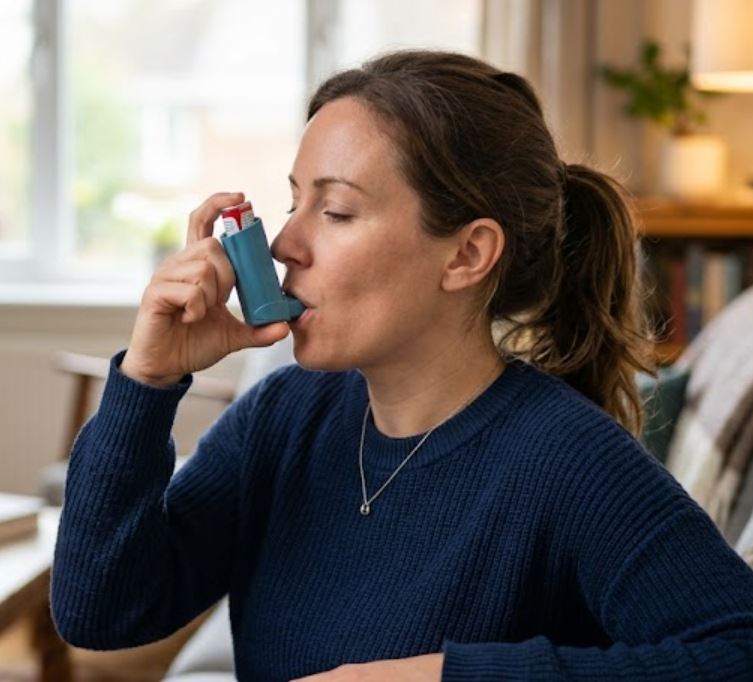
Pathophysiology and Bronchial Inflammation
Definition and Algerian context
Bronchial asthma is a chronic inflammatory disease of the airways characterized by bronchial hyperreactivity and variable airflow obstruction. In Algeria, it is the most prevalent chronic disease in children, with an estimated prevalence of 8.7%, highlighting the importance of standardizing dental care for this population.
This heterogeneous disease rests on an inflammatory cascade involving mast cells, eosinophils, T lymphocytes and epithelial cells — leading to bronchial remodeling that amplifies hyperreactivity to external stimuli.
Triggering stimuli in the dental office
- Resin dust during polishing or grinding procedures
- Rinse sprays or topical anesthetic aerosols
- Strong odors from chemical products (eugenol, solvents, resins)
- Stress and anxiety — the primary trigger in the dental office
- Strict supine position (diaphragmatic compression)
FeNO — Marker of active inflammation
- NO produced in excess via NOSII activation by inflammatory cytokines
- Elevated FeNO = active subclinical inflammation
- Heightened perioperative exacerbation risk even in asymptomatic patients
- Absence of declared symptoms does not guarantee absence of bronchial inflammation
GINA Classification — Control and Operative Risk
Risk stratification according to level of control
| Control level | Clinical features (4 weeks) | Implications for the clinician |
|---|---|---|
| Well controlled | Daytime symptoms ≤ 2/week · No nocturnal awakening · Reliever use ≤ 2/week | Routine care permitted — standard stress management precautions |
| Partly controlled | Daytime symptoms > 2/week · Nocturnal awakening · Activity limitation | Identify triggers · Light sedation feasible · Verify treatment adherence |
| Uncontrolled | ≥ 3 partly-controlled criteria · Frequent exacerbations | Defer elective care · Pulmonologist consultation · Emergencies in a secure setting |
Pre-appointment assessment — Five essential questions
- Has the patient had exacerbations or emergency visits in the past 4 weeks?
- Has the patient used their rescue bronchodilator more than twice per week?
- Is the patient carrying their rescue inhaler (salbutamol) today?
- Does the patient have a known sulfite allergy or nasal polyposis?
- Is the patient on long-term oral corticosteroids (adrenal insufficiency risk)?
Effects of Inhaled Medications on the Oral Cavity
Common mechanism — Oropharyngeal particle deposition
Asthma medications exert direct and indirect deleterious effects on both hard and soft oral tissues. These effects primarily result from the inhalation route of delivery, which promotes significant deposition of active substances in the oropharynx at the expense of the desired pulmonary distribution.
Adverse effects by therapeutic class
Salbutamol and fenoterol reduce total salivary flow by 26% and parotid saliva by approximately 36%.
Dry powder inhalers contain lactose monohydrate as an excipient — a fermentable substrate for S. mutans and Lactobacilli.
Frequent inhalation causes salivary pH to fall below the critical threshold of 5.5 for up to 30 minutes after each dose.
This repeated acidity promotes enamel erosion and irreversible demineralization of dental hard tissues.
Fluticasone and budesonide induce local immune suppression of the oral mucosa, promoting opportunistic proliferation of Candida albicans.
Risk is markedly higher without post-inhalation mouth rinsing or without a spacer device.
Ipratropium bromide inhibits parasympathetic stimulation of salivary glands, inducing severe dry mouth.
Combination inhalers (ICS + long-acting β2) combine reduced salivary flow with local immune suppression — cumulative risk.
Chairside Operative Protocols
Prefer morning appointments — respiratory function is statistically more stable. Limit session length to avoid physical and nervous exhaustion.
Strict supine position may aggravate dyspnea through diaphragmatic compression. A semi-reclined position is preferred to facilitate chest expansion.
Always confirm the patient has their rescue inhaler (salbutamol) at the appointment. Never begin treatment without this verification.
Anxiolytic and analgesic properties without bronchial irritation. The high oxygen concentration (50%) is inherently beneficial for the asthmatic patient. Preferred option for the anxious but well-controlled asthmatic.
Avoid during an acute episode or severe nasal obstruction (nasal breathing via the mask is essential). Deep sedation is contraindicated outside a hospital setting in very severe asthma — risk of respiratory depression.
Local Anesthesia and Vasoconstrictors
The sulfite debate — A rigorous assessment of actual risk
Anesthetic solutions containing vasoconstrictors require the addition of sodium metabisulfite as a preservative. In approximately 4% of severely corticosteroid-dependent asthmatics, sulfites can trigger an acute bronchospasm through a hypersensitivity reaction.
However, scientific literature shows that for 96% of asthmatics, the risk is extremely low. A standard restaurant meal can contain up to 200 mg of sulfites — approximately 27 times the dose present in a lidocaine with epinephrine cartridge.
Recommendations by patient profile
| Patient profile | Anesthetic choice | Rationale |
|---|---|---|
| Well-controlled asthma | Lidocaine with epinephrine | Vasoconstrictors are not contraindicated — deeper, longer-lasting anesthesia |
| Partly controlled asthma | Articaine or Lidocaine — with precautions | Slow fractional injection · Enhanced monitoring · Patient must have inhaler |
| Severe unstable asthma or known sulfite allergy | Mepivacaine 3% without vasoconstrictor | Eliminate any sulfite risk — action duration is sufficient |
| Samter's Triad (AERD) | Mepivacaine 3% — avoid epinephrine | Confirmed hypersensitivity background — maximum safety required |
Samter's Triad — NSAIDs and Analgesic Prescribing
History of respiratory reaction (dyspnea, wheezing, profuse rhinorrhea, urticaria) after taking aspirin, ibuprofen or naproxen. Documented nasal polyposis. Chronic severe asthma requiring long-term oral corticosteroids.
If one or more criteria are present: prescribe paracetamol exclusively. Inform the patient of the risk. Document in the patient file. Refer to an allergist or pulmonologist for full evaluation.
Analgesic prescribing recommendations — Reference table
| Drug | Risk | Recommendation |
|---|---|---|
| Aspirin | Severe bronchospasm (Samter's Triad) | Contraindicated if history of respiratory reaction |
| NSAIDs (Ibuprofen, Naproxen) | Asthma exacerbation via leukotriene shunting | Avoid — replace with paracetamol |
| Paracetamol (Acetaminophen) | Very low risk | First-line analgesic — well tolerated even in AERD |
| Opioids (Morphine, Codeine) | Histamine release · Respiratory depression | Extreme caution — use only with medical advice |
Emergency Protocol — Bronchospasm in the Dental Office
Recognition of severity signs
- Difficulty speaking or counting to 10 in a single breath
- Agitation, diaphoresis, cyanosis of the lips or fingernails
- Accessory respiratory muscle use — intercostal or supraclavicular retraction
- Respiratory rate exceeding 25–30 cycles per minute
- SpO2 < 92% on pulse oximeter reading
- Peak expiratory flow (PEF) < 50% of predicted value
Immediate management algorithm for acute bronchospasm
Life-threatening emergency — every second counts. Memorize this sequence and display it in the dental office.
- Remove all intraoral materials (rubber dam, instruments, cotton rolls)
- Clear the airway and prevent any accidental aspiration
- Sit or semi-recline the patient to assist inspiratory effort
- Never lay a patient in respiratory distress fully supine
- Administer 2 to 4 puffs of salbutamol (Ventolin) via metered-dose inhaler
- Use a spacer device to optimize pulmonary delivery of the drug
- Repeat every 20 minutes if needed (maximum 3 rounds)
- Administer O2 at 6–10 L/min via face mask
- Target: maintain SpO2 above 94%
- In Algeria: contact SAMU or Civil Protection if no immediate improvement
- Refractory episode: methylprednisolone (Solu-Medrol) 20–40 mg IV/IM or terbutaline 0.5 mg SC
- Associated anaphylaxis: epinephrine 0.3–0.5 mg IM into the thigh
Emergency Kit — Algeria
Regulatory composition — Recommendations from Algerian medical faculties (Constantine, Sétif)
| Equipment / Drug | Indication | Route of administration |
|---|---|---|
| Salbutamol (Ventolin) | Rapid-acting bronchodilator | Inhalation — 2 to 4 puffs via spacer |
| Terbutaline (Bricanyl) | Severe acute asthma resistant to salbutamol | Subcutaneous injection — 0.5 mg |
| Epinephrine (Adrenaline) | Anaphylactic shock / Refractory asthma | Intramuscular injection — 0.3 to 0.5 mg |
| Methylprednisolone (Solu-Medrol) | Episode refractory to bronchodilators | IV or IM injection — 20 to 40 mg |
| Medical oxygen | Hypoxemia / Respiratory distress | Face mask — 6 to 15 L/min |
| Spacer device | Optimize bronchodilator pulmonary delivery | Interface between inhaler and patient |
| Pulse oximeter | SpO2 monitoring | Finger probe — alarm if SpO2 < 92% |
Prevention and Patient Education
Systematic mouth rinse after every inhaler use with water, milk or 0.05% sodium fluoride solution. Neutralizes acidity and limits systemic corticosteroid absorption via the mucosa.
Do not brush immediately after inhalation — enamel is temporarily weakened by transient acidity. Wait 30 minutes before brushing.
Recommend a spacer device to reduce oropharyngeal deposition and improve pulmonary distribution of the inhaled medication.
Xerostomia management and remineralization
- Regular hydration with small sips of water throughout the day
- Sugar-free chewing gum to stimulate endogenous saliva production
- Professional application of fluoride varnish (especially in children)
- Pit and fissure sealants on vulnerable surfaces in asthmatic children
- High-concentration toothpaste (5000 ppm) if confirmed high caries risk
Algerian institutional framework
- Regular dental screening of children in school settings
- Special attention to asthmatic children during screening visits
- Public health dental inspectors: oversight of guideline implementation
- Combating childhood asthma: a school health priority (MSPRH)
Orthodontic Implications and Facial Growth
Chronic mouth breathing — Morphological consequences
Mouth breathing — a frequent consequence of nasal obstruction associated with asthma and allergic rhinitis — can have major morphological repercussions on facial skeletal development in children. The absence of physiological lingual pressure on the palate and the deviant breathing pattern are the primary mechanisms.
Dentofacial anomalies associated with persistent asthma — Increased prevalence
High and narrow palatal vault due to the absence of physiological lingual pressure against the palate.
Deficient transverse development of the maxillary arch.
Increased anterior facial height linked to chronic open mandibular posture.
Tendency toward skeletal hyperdivergence.
Significant overjet and increased risk of anterior open bite linked to low tongue posture and reduced lip muscle tone.
Increased traumatic risk to the maxillary incisors.
Deficient transverse arch development leading to significant dental crowding.
Posterior crossbite is frequently observed.
Clinical FAQ
References
Pathophysiology, epidemiology and GINA classification
-
1Guideline GINA. Global Strategy for Asthma Management and Prevention — Pocket Guide. Global Initiative for Asthma. 2024.
ginasthma.org — GINA Pocket Guide 2024 -
2Review Nitric oxide and asthma severity: towards a better understanding of asthma phenotypes. PMC / J Breath Res. 2024.
pmc.ncbi.nlm.nih.gov — FeNO and asthma phenotypes -
3Algeria Université de Tlemcen. Management of severe asthma in a pulmonology department. Dspace Tlemcen. 2023.
dspace.univ-tlemcen.dz — Severe asthma management in Algeria -
4Guideline Global Asthma Network. The Global Asthma Report 2022. GAN. 2022.
globalasthmanetwork.org — Global Asthma Report
Effects of inhaled medications on oral health
-
5Drugs prescribed for asthma and their adverse effects on dental health. PMC / Oral Health Prev Dent. 2023.
pmc.ncbi.nlm.nih.gov — Asthma drugs and dental health -
6Clinical study Impact of inhalation therapy on oral health. PMC / J Asthma. 2020.
pmc.ncbi.nlm.nih.gov — Impact of inhalation therapy on oral health -
7Pediatric study Dental management of pediatric patients with bronchial asthma. PMC / J Clin Pediatr Dent. 2022.
pmc.ncbi.nlm.nih.gov — Dental management of pediatric asthma patients
Local anesthesia, vasoconstrictors and conscious sedation
-
8Narrative review Pharmacological interactions of epinephrine at concentrations used in dental anesthesiology: an updated narrative review. PMC / Anesth Prog. 2023.
pmc.ncbi.nlm.nih.gov — Epinephrine in dental anesthesiology -
9Guideline AAPD. Use of nitrous oxide for pediatric dental patients. American Academy of Pediatric Dentistry. 2023.
aapd.org — Nitrous oxide for pediatric dental patients -
10Guideline SaferCare Victoria. Sedation in children with respiratory distress including asthma. Good Practice Point. 2022.
safercare.vic.gov.au — Sedation in children with asthma
Samter's Triad (AERD) and analgesic prescribing
-
11Guideline AAAAI. Aspirin-Exacerbated Respiratory Disease (AERD). American Academy of Allergy, Asthma & Immunology. 2024.
aaaai.org — AERD: definition and management -
12Review Aspirin-exacerbated respiratory disease: the dentist's role in recognition, referral, and management. SCIRP / Open Journal of Stomatology. 2021.
scirp.org — AERD and the dentist's role -
13PMC study Accidental ingestion of aspirin and NSAIDs is common in patients with AERD. PMC / J Allergy Clin Immunol Pract. 2022.
pmc.ncbi.nlm.nih.gov — NSAID ingestion in AERD patients
Dental office emergencies and emergency kit — Algerian context
-
14Algeria Faculty of Medicine, University of Constantine 3. Emergency drugs and emergency kit in the dental office.
facmed.univ-constantine3.dz — Dental emergency kit -
15Algeria Faculty of Medicine, University of Constantine 3. Medical emergencies in the dental office.
facmed.univ-constantine3.dz — Medical emergencies in the dental office -
16Review Management of medical emergencies in the dental office: conditions in each country, the extent of treatment by the dentist. PMC / Int Dent J. 2021.
pmc.ncbi.nlm.nih.gov — Medical emergencies in the dental office
Facial growth and orthodontics
-
17Pediatric study Dental management of pediatric patients with bronchial asthma — orthodontic implications. PMC. 2022.
pmc.ncbi.nlm.nih.gov — Orthodontic implications of asthma in children -
18Review Asthma and oral health — Links between asthma and dental health. Dental practice / PMC. 2023.
pmc.ncbi.nlm.nih.gov — Asthma and oral health links