
01
Why Choose a Class B Autoclave?
Instrument sterilisation in dental practice — A regulatory imperative
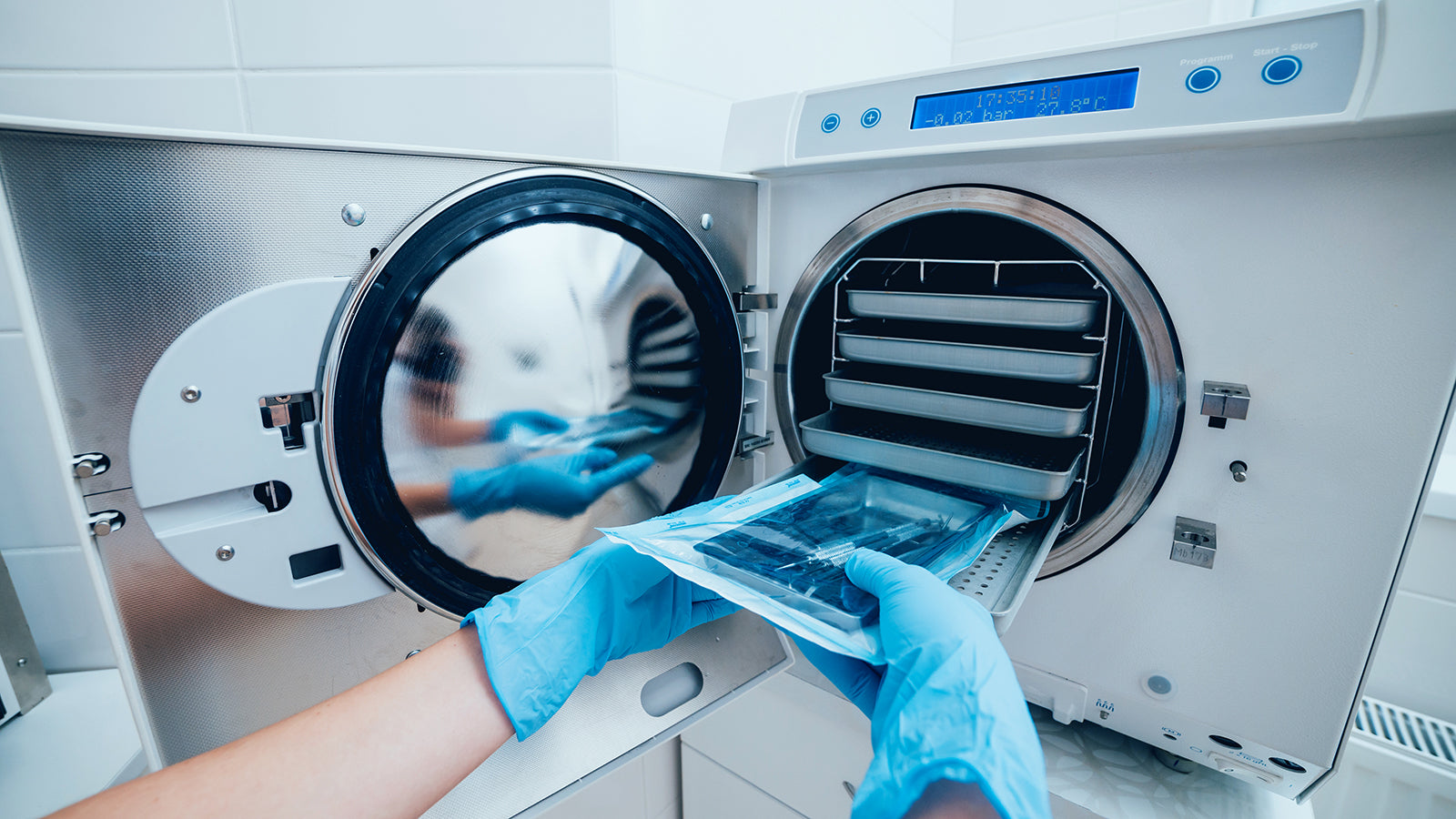
In dental clinics, instrument sterilisation is essential to guarantee patient safety. Class B autoclaves use saturated steam under pressure to eliminate all micro-organisms, including the most resistant bacterial spores.
While autoclaves may appear similar on the surface, they present considerable technical differences that are indispensable to understand before purchasing.
Class B — The superior standard
European standard EN 13060
- Sterilises porous and hollow instruments (turbines, contra-angles, suction cannulas)
- Fractioned pre-vacuum cycle before temperature rise
- Removes residual air by vacuum pump — guarantees steam penetration
- Mandatory for wrapped or complex dental instruments
- Compliant with modern hospital hygiene requirements
Class N — Important limitations
Not recommended for dentistry
- Suitable only for solid, unwrapped instruments
- No pre-vacuum — insufficient steam penetration for hollow items
- Does not effectively sterilise turbines or contra-angles
- Not compliant with current dental recommendations
EN 13060 Standard
Class B autoclaves comply with European standard EN 13060 and are the only units that guarantee complete sterilisation of porous, hollow and wrapped dental instruments. They are the mandatory standard for every modern dental practice.
02
Autoclave Capacity
8–12 L
Small capacity
- Solo or two-chair practice
- Limited daily workload
- Low energy consumption
- Compact footprint
- Accessible purchase price
16–18 L
Intermediate capacity
- 2 to 4-chair practice
- Excellent volume/cost ratio
- Appropriate cycle load
- Moderate energy consumption
- Best-selling size in dentistry
22–24 L
Large capacity
- Clinic or multi-chair centre
- High daily instrument volume
- Higher electrical consumption
- Longer cycle at full load
- Higher initial investment
Practical tip
Two small-capacity units (2 × 12 L) can be more practical than a single large model: rotating cycles run continuously, no complete stoppage if one unit fails, and load can be adapted flexibly to practice activity throughout the day.
03
Sterilisation Cycle Duration
Cycle durations by load type
| Cycle type | Total duration | Recommended use |
|---|---|---|
| Rapid cycle (134°C) | 20 to 30 min | Unwrapped instruments — emergency use |
| Standard cycle (134°C) | 35 to 45 min | Wrapped instruments — routine use |
| Porous cycle (121°C) | 50 to 70 min | Textiles, heat-sensitive products |
| Economy cycle (121°C) | 40 to 60 min | Mixed load — reduced water and energy use |
Rapid-cycle autoclaves
Advantages and limitations
- Complete cycle in 20–25 min — ideal for high-activity practices
- Reduced waiting time between patients
- More advanced technology — high-performance vacuum pump
- Higher purchase price (+20 to +40%)
- Slightly higher water and energy consumption
Standard-cycle autoclaves
The optimal quality/price compromise
- Cycle in 35–45 min — suits the majority of practices
- Excellent value for money
- Less mechanical stress — longer service life
- Sufficient for general dental practice
- Wide range of brands and models available
04
Warranty and Technical Service
Essential warranty and after-sales service criteria
- Require a warranty of at least 1 to 2 years covering parts and labour
- Confirm the presence of an authorised technical service centre locally in Algeria
- Verify availability of spare parts (seals, heating elements, vacuum pumps)
- Prefer brands with a multi-brand service network — greater flexibility
- Ask about average response time and the cost of annual maintenance visits
- Check whether annual preventive maintenance is included or available at a fixed rate
Risk with brands lacking a local network
A broken-down autoclave with no available technician can bring your practice to a standstill. A mid-range unit with a responsive local service is preferable to a premium brand with no technical support in Algeria.
05
Price and Brand Origin
Comparison by origin — Quality and positioning
| Origin | Brand examples | Positioning | Best suited for |
|---|---|---|---|
| European | Melag, W&H, Euronda, Dentsply | Premium | Large clinics, intensive activity |
| Italian / Spanish | Sordina, Gnatus, BMS | Good quality | Intermediate-sized practices |
| Turkish | BHT, Vartem, Tuttnauer | Mid-range | 2–4 chair practices |
| Asian | Runyes, Biobase, Shinva | Entry-level | Small practices, limited budget |
Purchasing advice
European and American brands generally offer better build quality, longer service life and more rigorous compliance documentation. Asian brands may suit small practices with a limited budget, provided CE certification is confirmed and local after-sales service is available.
06
Accessories and Traceability
Integrated traceability printer
Cycle documentation — regulatory requirement
- Automatic printout of parameters for each cycle
- Date, time, temperature, pressure, duration
- Mandatory in accredited facilities
- Evidence in the event of an audit or medicolegal dispute
- Some connected models export data to traceability software
Useful additional accessories
Optimising day-to-day use
- Integrated or external water distillation system
- Additional stainless steel trays and cassettes
- Sterilisation pouches with chemical indicators
- Biological indicators (Helix/Bowie-Dick tests)
- Cycle management and traceability software (USB/network)
Sterilisation monitoring indicators
| Indicator type | Recommended frequency | Purpose |
|---|---|---|
| Class 1 chemical indicators (tape) | Every pouch | Distinguish processed from unprocessed instruments |
| Bowie-Dick test | Every morning (first cycle) | Verify air removal (pre-vacuum) |
| Helix test (hollow lumen test) | Every working day | Validate steam penetration into hollow instruments |
| Biological indicators (Geobacillus) | Weekly or monthly | Confirm destruction of bacterial spores |
07
Automatic vs Semi-Automatic Autoclaves
Fully automatic autoclave
Continuous operation without manual intervention
- Complete cycle: sterilisation + automated vacuum drying
- Instruments dry and ready for use or storage at cycle end
- Door remains closed throughout the entire process
- Ideal for wrapped instruments (sterility maintained)
- More ergonomic — frees staff during the cycle
- Higher purchase price
Semi-automatic autoclave
Manual drying with door ajar
- Automatic sterilisation — drying with door open or ajar
- Additional drying time must be managed manually
- Lower purchase price — more economical
- Suitable for unwrapped instruments for immediate use
- Less recommended for wrapped instruments stored long-term
Drying — a critical point that is frequently overlooked
Incomplete drying promotes condensation inside pouches and can compromise the sterility of wrapped instruments. For instruments stored for more than a few hours, an autoclave with automatic vacuum drying is strongly recommended.
08
Chamber Material
Stainless steel (316L)
Reference material — most recommended
- Excellent resistance to corrosion and repeated cycles
- Withstands extreme thermal variations (121–134°C)
- Compatible with all cleaning and maintenance solutions
- Easy to clean and disinfect
- Service life of 10 to 15 years with proper maintenance
- Standard in all European and premium brands
Copper
Acceptable alternative — thermal properties
- Excellent thermal conductivity — rapid temperature rise
- Intrinsic antimicrobial properties
- More susceptible to corrosion than stainless steel
- More demanding maintenance (regular descaling essential)
- Found mainly in entry-level models
Water quality — a determining factor for longevity
Use only demineralised or distilled water. Tap water contains minerals (calcium, magnesium) that form scale on the heating element and inside the chamber, significantly reducing thermal efficiency and the unit's service life.
09
Safety Systems
Essential monitoring systems
- Pressure monitoring — automatic shutdown if the safety threshold is exceeded
- Temperature monitoring — continuous validation throughout the sterilisation plateau
- Water quality monitoring — alert if water level is insufficient or too hard
- Door sensor — automatic locking for the entire duration of the cycle
- Incomplete cycle detection with alert and journal entry
Advanced safety options
Preferred in premium models
- Automatic shutdown in the event of anomaly (safety valve)
- Dual separate reservoirs: clean water / used water
- Bacteriological filter on the feed water inlet
- Anti-backflow system preventing water circuit contamination
- Memory of recent cycles consultable without the printer
- Audible + visual alarm on cycle failure
Pre-purchase verification checklist
Check before signing
- Confirm CE marking compliant with EN 13060
- Request the full technical datasheet with validated cycle parameters
- Ask for the installation qualification procedure (IQ/OQ/PQ)
- Ensure the internal software is up to date and available in your language
- Physically test the unit before acceptance if possible
10
How a Sterilisation Cycle Works
The 6 phases of a complete Class B cycle
Understanding each phase enables rapid detection of anomalies and ensures full parameter traceability.
Phase 1 — Steam generation
- Demineralised water is heated by the element to boiling point
- Production of dry saturated steam
Phase 2 — Fractioned pre-vacuum (Class B exclusive)
- The vacuum pump removes air from the chamber in multiple stages
- Guarantees complete steam penetration into hollow items and packaging
- This is the defining characteristic of Class B
Phase 3 — Temperature and pressure rise
- Steam injection — pressure and temperature rise simultaneously
- 121°C / 1 bar or 134°C / 2 bar depending on the selected programme
Phase 4 — Sterilisation plateau
- Parameters maintained for 5 to 20 minutes depending on load
- Destruction of all micro-organisms and spores
Phase 5 — Depressurisation
- The exhaust valve progressively reduces pressure
- Avoids sudden depressurisation (risk of pouch rupture)
Phase 6 — Drying and cooling
- Post-cycle vacuum drying (automatic models)
- Cooling to a safe temperature before the door can be opened
- Audible signal and cycle validation displayed on screen
Clinical FAQ
For a two-chair practice with moderate activity, a 16-litre autoclave is generally sufficient. If activity is intensive (multiple extractions, implantology, surgery), consider 18 litres or two 12-litre units running in alternation. The decisive factor is the number of daily cycles required: estimate approximately 2 to 3 cycles per chair per day to determine the appropriate capacity.
Yes. Dental instruments such as turbines, contra-angles and suction cannulas are hollow and/or porous instruments that can only be properly sterilised by a Class B autoclave. Class N (without pre-vacuum) is insufficient for these instruments because steam cannot penetrate into internal cavities. EN 13060 and the recommendations of dental and health authorities require Class B for any facility performing invasive care.
Exclusively demineralised or distilled water (conductivity < 15 µS/cm). Tap water contains minerals (calcium, magnesium) that form scale on the heating element and inside the chamber, reducing thermal efficiency and the unit's service life. Use a domestic water distiller or commercially available distilled water. Never use spring or mineral water.
A well-maintained Class B autoclave has a service life of 10 to 15 years for quality European brands. The main longevity factors are: exclusive use of demineralised water, weekly chamber cleaning, quarterly descaling, and annual maintenance by an authorised technician (preventive seal replacement, vacuum pump inspection). Entry-level brands typically have a service life of 5 to 8 years.
Three daily checks are mandatory: (1) Bowie-Dick test every morning before the first patient cycle — validates air removal; (2) Helix test every working day — verifies steam penetration into hollow instruments; (3) Check the chemical indicators on every pouch after the cycle. Weekly or monthly, a biological test (Geobacillus stearothermophilus) confirms spore destruction. Retain all cycle printouts for at least 5 years.